

The chimney's function and significance
The primary function of the chimney is to direct smoke away from the wood burning stove and out of the house. However, this is not the chimney's only function, as it must also ensure that enough air is drawn into the wood burning stove so that the fire burns optimally.
How the chimney affects your stove
For a wood burning stove to function optimally, there must be sufficient draft in the chimney. The chimney is the stove's motor, driving the combustion, and without a well-functioning chimney with correct draft, the stove does not burn properly. This can cause ignition problems, smoke in the living room, poor combustion, and smoke development, which can be a nuisance to the neighbourhood.
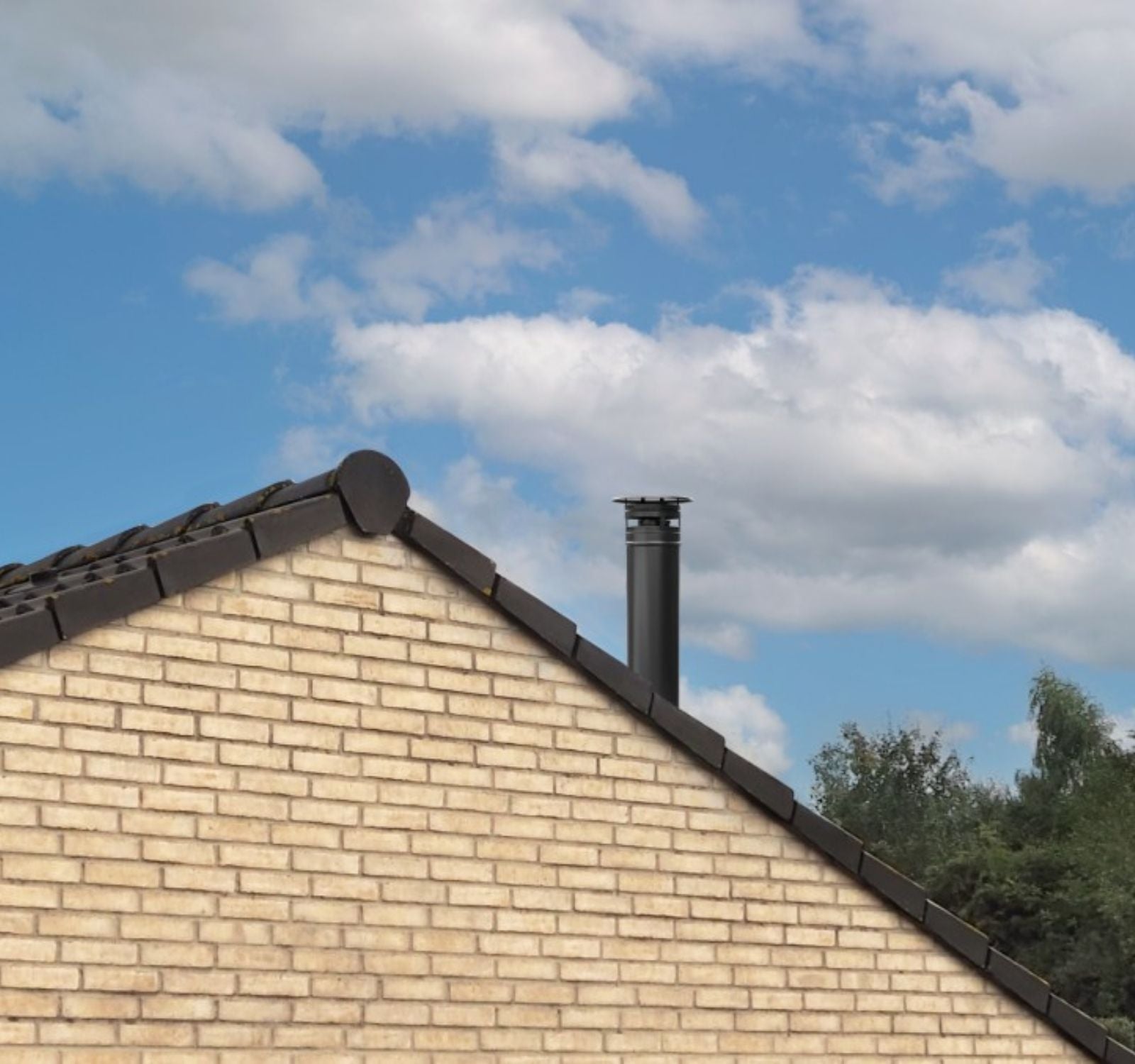
The heat in the smoke creates the chimney draft. The draft arises due to the temperature difference between the air/smoke inside the chimney and the temperature outside. This creates an upward airflow, which is strengthened the higher the chimney is and the better the chimney is insulated. Steel chimneys are therefore usually better than masonry chimneys, as they heat up faster and more easily and retain heat better due to good insulation. You can read more about Aduro Steel Chimneys here.
The ideal chimney draft is between 12-15 Pascal, Pa, but it naturally varies throughout the year, being highest in winter and lowest in the summer months.
The cooperation between the wood burning stove and the chimney is thus dependent on a correct chimney draft. This factor is essential when evaluating the placement of the stove and especially the height of the chimney. Read more about the chimney's placement under the tab "Placement". Surrounding tall trees, buildings, and the house's position (high/low) impose requirements on the height of the chimney. The wind outside also plays a role, as it can enhance or reduce the draft depending on local conditions, so here the height of the chimney is also crucial.
Wood burning stoves in low-energy houses
Another and new important factor to consider is the condition of the house. Today, houses are isolated more often compared to 10 years ago. Low-energy houses with ventilation systems and large cooker hoods are being build, causing a "fight" for air. This often results in the stove losing its “breath”. In this case, we recommend an Aduro stove with air-connection (external air supply).
Placement
The chimney’s placement on the roof is critical to the chimney draft. Below is an illustration of the three zones your chimney can be placed in, along with their effect on the chimney’s draft.
Zone 1
In zone 1 you can be relatively sure that the chimney’s draft is good. The draft will, however, be affected by tall trees and other buildings nearby the chimney.
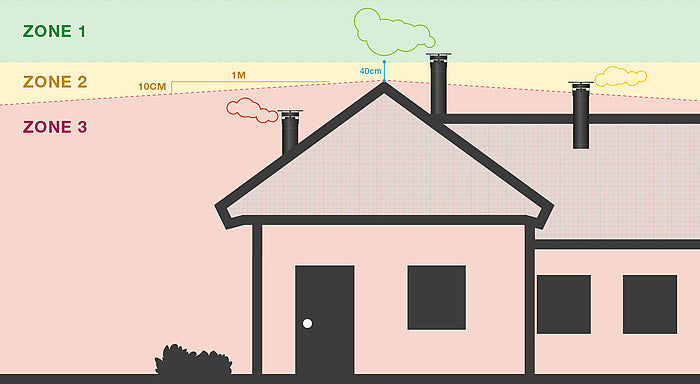
Zone 2
In zone 2 you can experience bad chimney draft in periods. The draft will be particularly affected by the wind direction, while big trees and other buildings nearby the chimney can also have an effect on the draft.If you experience difficulties in zone 2, it can be remedied by extending the chimney so it is placed in zone 1, or you can mount an Aduro DraftOptimizer.
Zone 3
In zone 3 you will experience, that the chimney’s draft is often poor.We recommend installing an Aduro DraftOptimizer upon installation to avoid difficulties.
What influences chimney draft?
The chimney draft plays a vital role in how well your wood burning stove operates. There are several possible reasons for poor chimney draft; below are the most common:
- The chimney is too short and does not reach above the roof ridge.
- The house is shielded by tall trees or neighbouring buildings.
- The chimney is not airtight and lets in false air (for example, due to missing joints or poor insulation).
- There is negative pressure in the house, so the wood burning stove does not receive sufficient air (caused by an extractor hood or ventilation system).
- The house is insulated too well, restricting the air supply needed for combustion in the wood burning stove.
Improving poor chimney draft
A poor chimney draft can in some circumstances be improved by having a higher flue gas temperature, thus making the ignition very important. By using dry wood, you will experience a better combustion and a higher temperature in the stove, which will increase the draft in the chimney. Conversely, moist firewood can aggravate the chimney draft, as it lowers the temperature in the stove, giving less buoyancy in the chimney. We recommend using split birch or beech with a moisture content of max. 18%.
If the effect is not achieved by proper ignition, you can create a better chimney draft by:
- Extending the height of the chimney
- Installing a smoke exhauster – e.g. Aduro DraftOptimizer
- Securing the chimney for leaks
If necessary, talk to your local chimney sweep and let him evaluate the chimney.